
Green Tea More than a Health Drink
Extract from RFC Brisbane Newsletter, June 1992
SCIENTIFIC NAME: Camellia sinensis
FAMILY: Theaceae
Drinking green tea brings
health and longevity, wrote Eisai, founder of Buddhism's Rinzai sect.
That was back in the early 13th century when green tea was valued for
its medicinal qualities.
Today Kazutami Kuwano, assistant
professor at Tokyo Kasei Gakuin Junior College, takes this idea one
step further - why not eat the leaves used to make Japan's most popular
drink?
The nutritional properties in green tea can prevent or
cure diabetes, constipation, hemorrhoids, diarrhea, the common cold,
aging and other health problems.
The caffeine in the tea helps
relieve mental and physical fatigue, while the theanine, particular to
green tea, counteracts the negative effects of caffeine.
Green
tea is also good for preventing bad breath. Tannin, which gives green
tea its yellow colour, has sterilizing powers and works against the
leftover particles of food that can lead to halitosis. Lotte Company
Ltd uses green tea leaves in making Clorets, the gum known for killing
bad breath.
According to Kuwano, black and oolong teas are much
poorer in nutritional value because their leaves lose ingredients like
chlorophyll in the fermentation process. His experiments also show that
black tea actually reduces the weight of rat embryos.
Among the
beneficial attributes of tea, Kuwano singled out the power of green tea
to prevent cancer and reduce fat as the most remarkable.
Kuwano's
experiments on rats show that the catechin (which gives tea its puckery
taste) and vitamins in green tea create unfavorable environments for
the development and growth of tumors.
Vitamin C also quickens
the oxidation and discharge of cholesterol. Sencha and gyokuro,
high-quality green tea, are especially rich in vitamin C.
The catechin in green tea might also help to cure AIDS, a cancer center in Aichi announced in a March report.
"There
are, however, nutrients that cannot be ingested in the form of tea."
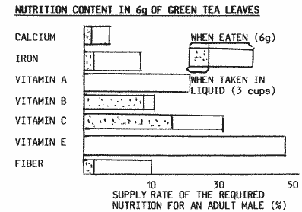
According to Kuwano, vitamin A and E are lost as they are not
water-soluble.
The intake of calcium, iron, vitamin C and fiber
is halved by the time the leaves are imbibed as tea. "In making three
cups of green tea we use, on average, 6 grams of tea leaves. If we ate
that amount of tea leaves every day, just a teaspoon at each meal, we
would ingest 50 percent of the vitamin E and 20 percent of the vitamin
A required in the daily calorie intake of an adult male. Tea leaves
have almost no calories, though." Kuwano said.
He explained that 10 times the nutritives in raw tea leaves are packed into dried leaves of the same weight.
According
to Kuwano: "We also have tea leaves from Matcha, powdered tea used in
the tea ceremony. But recently matcha is grown in the shade with the
result that its vitamin C is one-fourth and its vitamin E is one-half
the amount in green-tea leaves."
"I like to have powdered tea
leaves sprinkled on rice. That's my favourite." said the assistant
professor. In order to eat the tea leaves, they must first be ground in
a mill. Kuwano said the mills used for sesame seeds will do just fine.
Then the powdered green tea leaves can be dusted on or mixed with
almost any dish - natto, tofu, tempura, salad, sandwiches, hamburger
steaks, spaghetti, fried chicken and more.
"The secret is to
sprinkle the leaves on the dish right before eating. In the case of
juicy foods, leaves should be soaked for a while beforehand," he said.
An
elementary school in Ikebukuro, Tokyo, serves pupils dishes sprinkled
with green-tea leaves twice a month. "Seventy-six percent of the pupils
said the dishes were good. One-fourth of the students said they did not
notice the taste of the leaves. Obviously we can see the green colour,
but we can hardly detect any taste," Kuwano said.
"I eat tea
leaves every day at every meal," said Kuwano. For potential tea-leaf
lovers, edible powdered tea leaves will be sold beginning in May by
Yamaei Co. Ltd.
Back to
Tea Page
|